Transparent method
How the concrete bag calculator compares declared yields
Calculate or import volume, select an allowance if needed, and divide the adjusted cubic feet by each declared yield. Bag counts round up once, with unused nominal capacity shown per product.
- 01
Establish the volume once
Use dimensions for one rectangular design and its identical whole-number quantity. Use known volume when a separate takeoff already handles a round, tapered, or composite shape. Check whether that imported amount already includes an allowance; if it does, leave the allowance here at zero to avoid duplicating the contingency.
- 02
Choose which product families to display
Compare both shows four QUIKRETE Concrete Mix No. 1101 records and three SAKRETE High-Strength Concrete Mix records. A family filter narrows the comparison without changing volume. The table identifies each exact package record rather than assuming that every bag of the same weight produces an interchangeable material.
- 03
Apply the declared yield for each size
The listed QUIKRETE yields are 0.300, 0.375, 0.450, and 0.600 ft³ for 40, 50, 60, and 80 lb bags. The listed SAKRETE yields are 0.300, 0.450, and 0.600 ft³ for 40, 60, and 80 lb bags. These values belong to the recorded U.S. products and check dates.
- 04
Round whole bags and inspect capacity
A fractional sealed bag cannot be the final purchase count, so each result rounds upward only after volume and allowance are complete. Unused capacity is the nominal yield of that whole count minus the requested order volume. It is a rounding remainder, not guaranteed recoverable concrete after mixing and placement.
| Output | Formula |
|---|---|
| Net rectangular volume | length × width × thickness × identical quantity |
| Order volume | net ft³ × (1 + allowance ÷ 100) |
| Whole bags per record | ceiling(order ft³ ÷ declared ft³ per bag) |
| Unused nominal capacity | whole bags × declared ft³ per bag − order ft³ |
Field context
Compare package records before choosing a bag size
The concrete bag calculator compares the same volume against several declared yields. More bags of a smaller package can describe the same nominal capacity as fewer larger bags. Neither count alone establishes handling suitability, local stock, mixing arrangements, or whether the product meets the project specification.
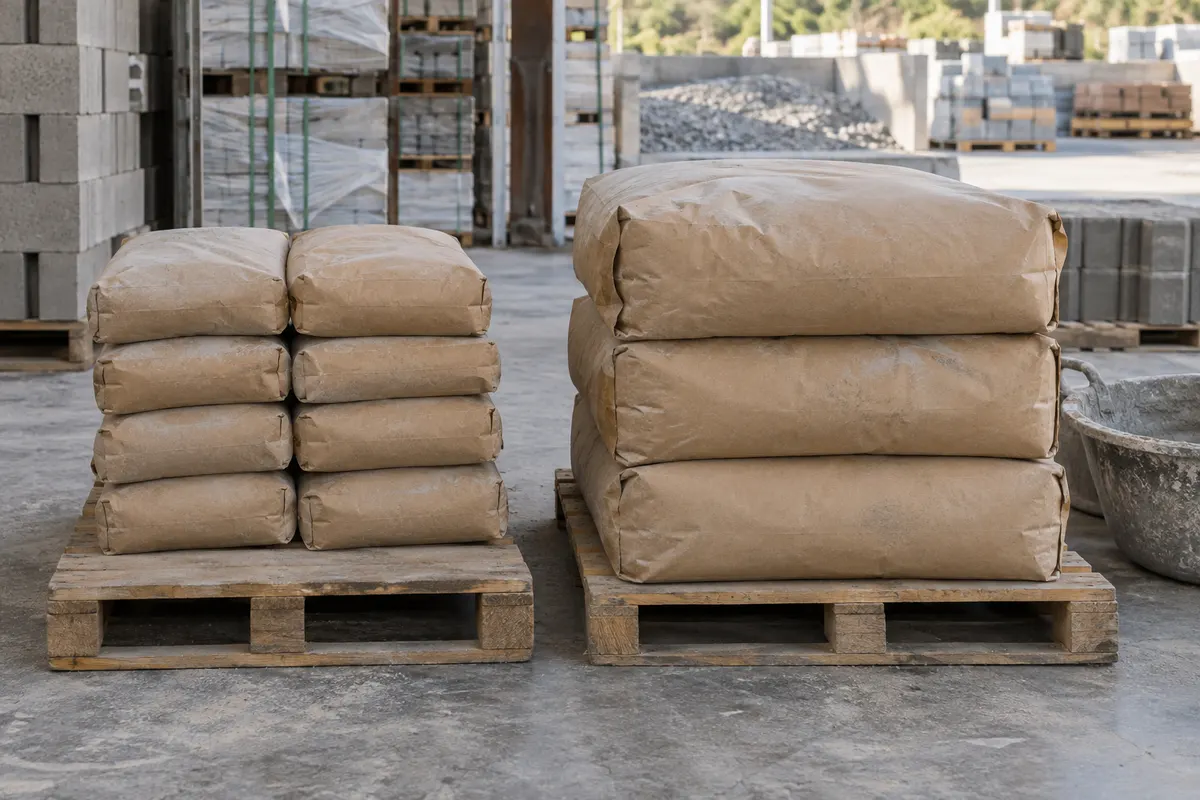
Plain unbranded bags illustrate different package sizes without reproducing manufacturer packaging or implying affiliation. Actual package identity matters more than the appearance of a stack. Match the product name, bag weight, item number, region, label yield, and current instructions before carrying a calculated count into a purchase.
Check the arithmetic
Worked example: one cubic yard across seven package records
Enter known volume of 1 yd³, which is exactly 27 ft³, and leave allowance at 0%. For QUIKRETE Concrete Mix No. 1101, the 40, 50, 60, and 80 lb records require 90, 72, 60, and 45 whole bags respectively. Each option has exactly 27 ft³ of nominal declared capacity for this example.
For the listed SAKRETE High-Strength Concrete Mix records, the 40, 60, and 80 lb options require 90, 60, and 45 bags. The matching counts follow from the matching recorded yields; they do not establish that the two products have identical specifications, availability, or application limits.
With a selected 10% allowance, order volume is 29.70 ft³. The listed 80 lb options each require 50 bags with 30.00 ft³ of nominal capacity and 0.30 ft³ unused capacity. This concrete bag calculator keeps that remainder separate from the 2.70 ft³ allowance, because purchasing increments and planning contingency are different quantities.
Use the result correctly
Use the comparison without mixing product assumptions
01 Read each count as an alternative
The seven displayed counts each cover the whole entered volume independently. Do not sum them into a shopping list. If you intend to combine package sizes, prepare a separate allocation with the chosen products and retain their total declared capacity; this comparison does not optimize a mixed-size order.
02 Match the current local package
The result uses existing U.S. records with their original check dates. Products, packaging, and availability can change. Check the package and source document before buying, especially when a retailer uses a similar product name or a different regional formulation. Bag weight by itself does not verify yield.
03 Separate handling and suitability from arithmetic
A smaller bag may change the number of units handled, but this concrete bag calculator does not assess lifting limits, crew productivity, mixer capacity, working time, or product suitability. Use the current manufacturer instructions and project requirements to plan mixing and placement after checking the arithmetic.
Sources and assumptions
Reference record
- QUIKRETE Concrete Mix No. 1101 data sheet — the existing verified authority record for this calculation task. Concrete Mix No. 1101 data sheet, revised October 2022; US; checked .
- SAKRETE High-Strength Concrete Mix product page — declared yields for the listed U.S. SAKRETE packages. U.S. product page, Product Details; US; checked .
- SAKRETE published product guide — item numbers associated with the listed SAKRETE sizes. SAKRETE Product Guide, 2021; US; checked .
- NIST Handbook 44, Appendix C — conversion of imported volumes to cubic feet. NIST Handbook 44—2026, Appendix C; US; checked .
QUIKRETE records were checked August 28, 2026; SAKRETE records July 30, 2026. Weights, yields, item numbers, URLs, regions, and document versions retain those check dates, not the page publication date.
Questions before ordering
Concrete Bag Calculator FAQ
How does this differ from the SAKRETE calculator?
The SAKRETE page selects one named product size for a rectangular pour. This concrete bag calculator displays several sizes side by side across two product families and also accepts known volume. Each visible record includes provenance and its own unused capacity, so the comparison can be checked directly.
Why do the two brands sometimes show the same count?
The listed records share declared yields at 40, 60, and 80 lb. The same required volume divided by the same yield gives the same count. That arithmetic does not imply matching ingredients, strength development, application limits, or manufacturer instructions.
What does the headline bag count represent?
It represents the selected reference bag within the visible family selection. Compare both starts with the QUIKRETE 80 lb reference, identified in the result label. You can select another record. The headline is one alternative count, not a combined order or a brand recommendation.
Is unused capacity the same as waste allowance?
No. Allowance increases the requested volume before bag division. Unused nominal capacity is what remains because the final count must be a whole number. The two values can differ, and an exact bag boundary can leave zero unused capacity even when an allowance was selected.
Can I use these counts for other bagged mixes?
Only when the exact product record and declared yield match. Fast-setting, lightweight, repair, mortar, sand/topping, and other regional mixes may have different yields. Use their current package data in an appropriate separate calculation instead of substituting a weight-only conversion.
Planning boundary
What this result does not decide
Product-specific quantity comparison only. This concrete bag calculator does not recommend a manufacturer, verify local availability, design a mix, choose a structural specification, or plan mixing and placement. Confirm the current product, region, package yield, application limits, instructions, and order quantity before purchase.
Independent third-party comparison. QUIKRETE and SAKRETE names identify public product records only. This site is not sponsored, endorsed by, or affiliated with either manufacturer.