Transparent method
How the concrete slab quantity is calculated
The slab branch deliberately stays narrow: one rectangular design, an optional repeated quantity, and one explicit allowance. It does not become the future multi-area procurement page, compare supply methods, estimate installed cost, or decide thickness, reinforcement, joints, base preparation, or strength.
- 01
Measure one slab inside the forms
Enter the formed length and width, then use the drawing- or project-specified thickness. A thickness error applies across the entire footprint, so keep inches, feet, centimeters, or millimeters attached to the actual measurement instead of converting by memory.
- 02
Use quantity only for identical slabs
Quantity multiplies one complete slab volume after unit conversion. If slabs differ in length, width, thickness, edge geometry, or deductions, calculate them separately; this page is not a multi-region takeoff that hides unlike sections in one average.
- 03
Keep net volume and allowance separate
The default allowance is 0%. When you select another percentage, the calculator preserves the exact net cubic feet and reports the added order volume independently so the assumption can be reviewed against field conditions and supplier guidance.
- 04
Treat bag counts as product equivalents
Whole-bag results use the declared U.S. yields for QUIKRETE Concrete Mix No. 1101 and round up once after the allowance. Match the current package and product record before purchase; bag weight by itself does not prove yield.
| Output | Formula |
|---|---|
| One slab | length × width × thickness |
| Net project volume | one-slab volume × identical slab quantity |
| Order volume | net volume × (1 + allowance ÷ 100) |
| Whole bags | ceiling(order ft³ ÷ declared product yield per bag) |
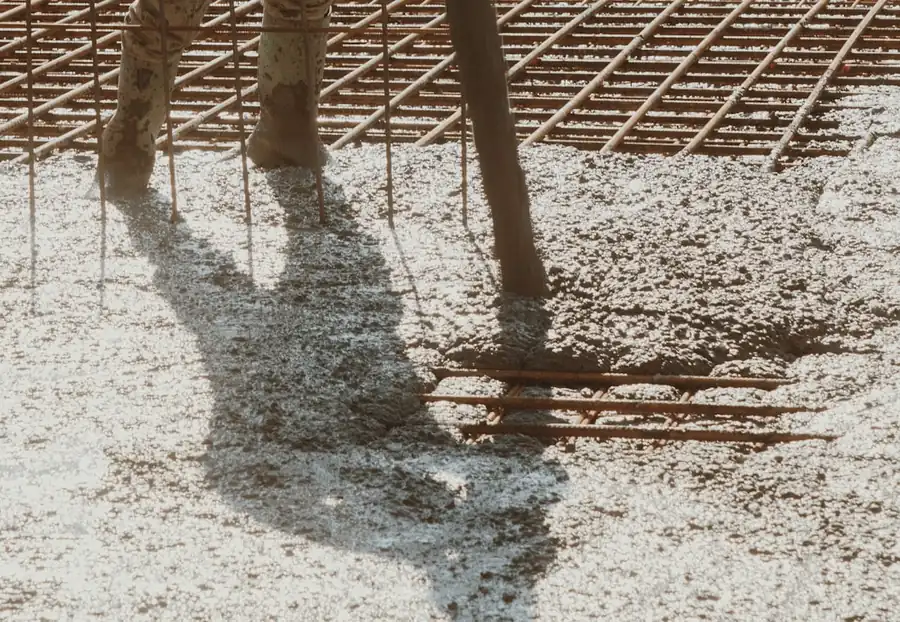
Field context
Measure slab thickness across the full formed footprint
The concrete slab calculator multiplies thickness across every square foot of the entered plan area. That makes thickness a high-leverage input: a small measurement difference is repeated across the whole slab rather than confined to one edge.
The field image also shows why volume math is only one part of the work. Reinforcement, support, cover, placement sequence, screeding, joints, and curing remain construction or design decisions. Enter dimensions from approved information and use the result only to prepare a material conversation.
Check the arithmetic
Worked example: two 10 ft × 12 ft slabs at 4 in
Convert 4 inches to 0.333333 feet. One slab is 10 × 12 × 0.333333 = 40 ft³. Two identical slabs therefore total 80 ft³, which is 2.962963 yd³ or 2.265348 m³ before any allowance.
At a deliberately selected 10% scenario, order volume becomes 88 ft³ or 3.259259 yd³. Using the rechecked 0.60 ft³ declared yield for the listed 80 lb product, 88 ÷ 0.60 = 146.666667 and rounds up once to 147 bags. Neither 10% nor that product is a universal recommendation.
| Slab area | 4 in | 5 in | 6 in | 8 in |
|---|---|---|---|---|
| 50 ft² | 0.62 yd³ | 0.77 yd³ | 0.93 yd³ | 1.23 yd³ |
| 100 ft² | 1.23 yd³ | 1.54 yd³ | 1.85 yd³ | 2.47 yd³ |
| 200 ft² | 2.47 yd³ | 3.09 yd³ | 3.70 yd³ | 4.94 yd³ |
| 400 ft² | 4.94 yd³ | 6.17 yd³ | 7.41 yd³ | 9.88 yd³ |
Use the result correctly
Keep the slab result inside its planning boundary
01 Do not use quantity for unlike pours
Two slabs can share a quantity only when all entered dimensions match. Thickened edges, ramps, recesses, trenches, openings, or separate pour stages require independently measured components so overlaps and deductions stay visible.
02 Select thickness outside this tool
Loads, soil, base, frost exposure, drainage, reinforcement, joints, concrete properties, and local requirements can govern slab design. This calculator performs arithmetic on the thickness you provide and makes no structural recommendation.
03 Confirm the purchasing basis
Ready-mix suppliers can apply minimums or order increments, while packaged products vary by exact mix and region. Carry the unrounded yardage, selected allowance, placement information, and current product or supplier data into the final order check.
Sources and assumptions
Reference record
- NRMCA CIP 8 — Discrepancies in Yield — formwork measurement and sufficient order-quantity guidance. CIP 8—Discrepancies in Yield, revised 2016; US; checked .
- QUIKRETE Concrete Mix No. 1101 data sheet — declared U.S. yields for the displayed 40, 50, 60, and 80 lb product records. Concrete Mix No. 1101 data sheet, revised October 2022; US; checked .
- NIST Handbook 44, Appendix C — U.S. and metric volume conversion reference. NIST Handbook 44—2026, Appendix C; US; checked .
Geometry uses the shared rectangular-prism and unit-conversion functions. The QUIKRETE Concrete Mix No. 1101 data sheet was rechecked August 28, 2026; its listed yields are product-specific reference values, not universal bag-weight conversions. The downloadable table contains net geometry only and uses formula version 1.0.
Questions before ordering
Concrete Slab Calculator FAQ
How much concrete is needed for a 10 × 10 slab at 4 inches thick?
The exact net volume is 33.333333 ft³, 1.234568 yd³, or about 0.944 m³ for one slab. That is before any selected allowance, supplier minimum, or order increment.
Can the calculator handle several slabs?
Yes, when they have identical length, width, and thickness. Enter the whole-number quantity and the calculator multiplies the unrounded one-slab volume. Calculate different slab designs separately instead of averaging them.
Does the result include a waste allowance automatically?
No. The default is 0%, and net volume always remains visible. You may compare 5%, 10%, or 15% scenarios, but the page does not assert that any percentage is correct for your placement.
Are the displayed bag counts universal for every concrete mix?
No. They are equivalents based on the named U.S. QUIKRETE Concrete Mix No. 1101 records and their declared yields. Verify the exact current package, region, label yield, and application before buying.
Does this concrete slab calculator choose thickness or reinforcement?
No. It calculates volume only from the dimensions supplied. Thickness, concrete specification, reinforcement, base, joints, drainage, frost protection, and capacity must come from approved project information or qualified local guidance.
Planning boundary
What this result does not decide
Material-volume and product-equivalent estimate only. This page does not design a slab, select thickness, concrete properties, reinforcement, joints, base, drainage, curing, placement sequence, or supplier order quantity. Verify dimensions, approved plans, current product data, field conditions, and supplier requirements before purchase.